| |
"How do you pick the translations of the Chinese words in Han Trainer ?" |
|
Here's an excerpt from our own guidelines to illustrate this:
As a Chinese native speaker, you may consider all meanings of a word to be important. But keep in mind that a German speaker (for example) is primarily interested in how he can use a word (= “standalone translation”) – not what it means as well (“no – translation meanings”).
General rule: If a meaning isn't really important, don't include it! Most learners prefer to see less translations und meanings than too many. Focus on the important stuff!
- The important stuff are the valid standalone translations of a word.
- You are not required to list all meanings a Chinese word can have, but you are required to list all different standalone translations of that Chinese word.
- Include meanings only
- If they are really essential and important
- If a word has only meanings but no valid standalone translations
Finally, if you decide to include no-translation meanings, proceed as follows:
In every mother tongue, write all no-translation meanings between <m></m> tags.
Let's take the word “ bia3o ” (表) as an example:
Translation 1: watch
Translation 2: <m>surface</m>
This enables Han Trainer to recognize if there are no-translation meanings among the translations of a word.
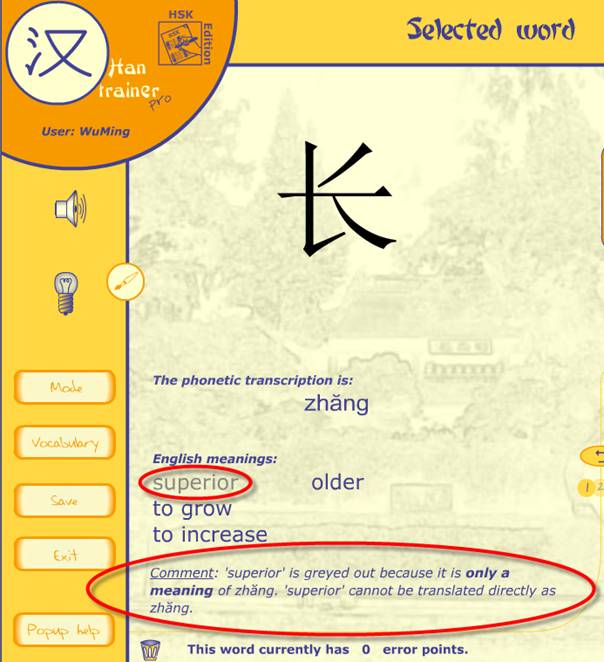
No-translation meanings will be displayed in a different color (grey) in the software, in the vocabulary list and on the learning cards.
When a word with standalone translations and no-translation meanings is displayed in Han Trainer,
- all no-translation meanings will be displayed in grey color
- The text: “'superior' is greyed out because it is only a meaning of zha3ng zhang. 'superior' cannot be translated directly as zhang.” will appear in comment line if it's not yet occupied
- As an answer, the no-translation meaning will be accepted like a normal translation
More examples:
- biao_surface
- „a watch” can be 表 or手表, so this is a valid standalone translation.
- “surface” cannot be translated as 表 . It would be translated as 表面 , so this is a no-translation meaning (it is rather important, so write „<m>surface</m> into the vocabulary repository XLS file)
- Preferably, the filename should be “biao_watch.swf”, but there is no need to change this for existing files
- lai_come
- “to come” can be 来 or 过来 , so this is a valid standalone translation.
- “to take place” cannot be translated as 来 . It would be translated as 带来 , so this is a no-translation meaning (write „<m>to take place</m> into the vocabulary repository XLS file if this meaning is really important)
- “the next” cannnot be translated as 来 . It would be translated as 未来 , so this is a no-translation meaning (write „<m>the next</m> into the vocabulary repository XLS file if this meaning is really important)
- tian_day
- “day” is a valid standalone translation
- “sky“ is a valid standalone translation for 天 . It can also be translated as 天空 , but this doesn't matter here.
- “heaven“ cannot be translated as 天 . It would be translated as 天堂 , so this is a no-translation meaning (write „<m>heaven</m> into the vocabulary repository XLS file if this meaning is really important)
- yi_one
- “one” is a valid standalone translation
- There are also combinations such as 一起 , where 一 has the meaning « all », or
?? , where 一 has the meaning „when“, but not all of them are important. In this case « all » is an important meaning (write „<m>all</m> into the vocabulary repository XLS file), but « when » is not an important meaning and can be ignored (don't include it into the XLS file). Generally, we only want meanings that are really important.
- yao_important
- ”important” cannot be translated as 要 . It would be translated as 要紧 (yaoqing), so this is a no-translation meaning (write „<m>important </m> into the vocabulary repository XLS file)
- ”essential” ( 必要 ) is another meaning of 要 , but it's not an important meaning. Generally, we only want meanings that are really important . This one isn't, so it can be ignored (don't include it into the XLS file).
- ”to want” can be translated as 要 or 想要 , so this is a valid standalone translation. It should be put at the beginning (i.e. into the translation1 field).
- Preferably, the filename should be “yao_want.swf”, but there is no need to change this for existing files.
- gui_expensive
- ”expensive” can be translated as 贵 or 昂贵 , so this is a valid standalone translation.
- ”valued” cannot be translated as 贵 . It would be translated as 珍贵 , so this is a no-translation meaning (write ”<m>valued</m>” into the vocabulary repository XLS file if this meaning is really important)
All content is protected under German and international copyright laws.
imprint & contact information | privacy policy | cookie settings